How AI SDRs Fit Your Sales Stack: Voice, Chat, WhatsApp and CRM (2026)
How an AI SDR ties voice, chat, WhatsApp, and your CRM into one outbound-to-booked-meeting pipeline. The orchestration guide for your 2026 sales stack.
How AI SDRs Fit Your Sales Stack: Voice, Chat, WhatsApp and CRM (2026)
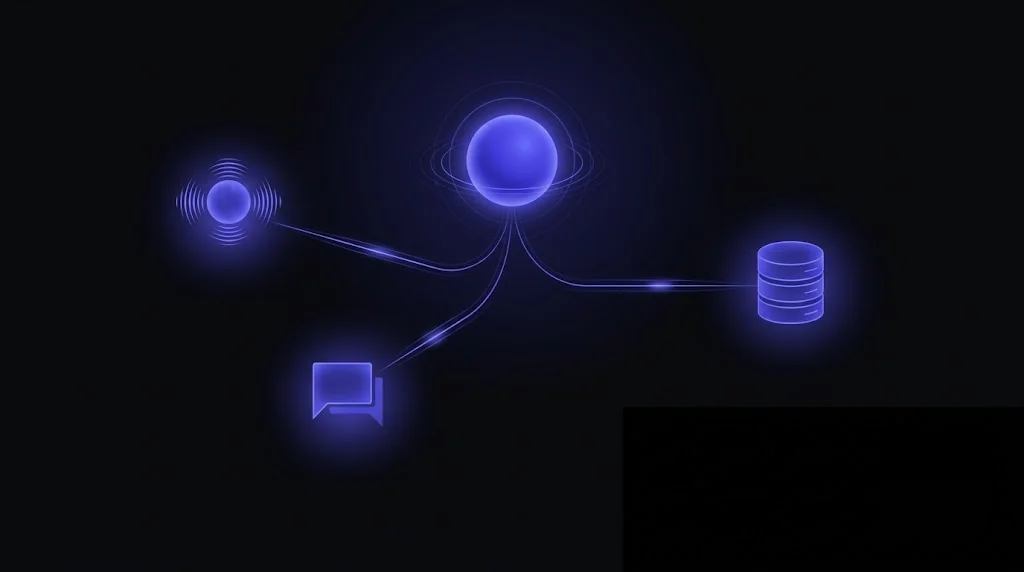
The short version: an AI SDR is the orchestrator of your outbound motion, and the channels are its hands. It reads your CRM to decide who to contact, sends personalized outreach, hands an engaged prospect to a voice, WhatsApp, or web chat agent to qualify, books the meeting through an appointment agent, and writes every step back to the CRM. One pipeline, from cold prospect to booked meeting.
If you have read our earlier posts on voice agents, WhatsApp agents, lead-gen chatbots, and appointment booking, you have met all the parts. This is the capstone: how the AI SDR ties them into a single sales stack. For the category basics, start with what an AI SDR is; this post is about the wiring.
What does an AI SDR orchestrate?
An AI SDR is not another channel - it is the layer above the channels. Each channel already exists as its own agent, and they all share the same LLM, tool-calling, and CRM backbone:
- A voice agent makes and takes calls.
- A WhatsApp agent runs persistent messaging threads.
- A web chat agent (the lead-gen chatbot) talks to on-site visitors.
- An appointment-setter agent books the meeting on a rep’s calendar.
The AI SDR’s job is the decisions those agents cannot make on their own: who to contact, on which channel, when, and what to do next. It sources and enriches prospects, triggers the first touch, watches for engagement, routes the conversation to the right channel agent, and orchestrates the handoffs. The channel agents are specialists; the SDR is the conductor deciding when each one plays.
Because the heavy engineering - qualification logic, CRM write-back, escalation rules - is built once and shared, adding the SDR on top is an orchestration problem, not a rebuild.
How do the channels hand off?
The handoff is the whole trick, and it hinges on one thing: a verified phone number that lets a lead move cleanly between channels without losing context.
The typical flow: the SDR sends outreach over email or LinkedIn. When the prospect replies or clicks, the SDR does not keep the conversation in the inbox - it moves them to a channel built to converse and qualify. If they are on your site, web chat engages them immediately. If you have a consented number, the SDR opens a WhatsApp thread you can return to for days. If intent is high or the moment is urgent, it triggers a voice call within seconds. Our channel comparison on WhatsApp vs web chat vs voice covers which one to reach for at each stage.
The reason this works is the shared backbone. A verified number plus one CRM means the same lead record follows the prospect across every channel, so the WhatsApp agent picks up exactly where the email left off, and the voice agent opens the call already knowing the history. The channel is the front door; the CRM is the house.
How does the CRM tie it together?
The CRM is the system of record, and the AI SDR both reads it and writes to it constantly.
It reads the CRM to decide who to contact next and to see prior activity - so it never cold-opens a lead it already spoke to, and it personalizes every touch with real context. It writes to the CRM at every step: outreach sent, responses received, qualification score, channel used, and the booked meeting. By the time a human rep picks up, the record holds the entire journey.
This is the same function-calling pattern each channel agent uses to talk to HubSpot, Salesforce, or Zoho - our guide on wiring AI voice agents to your CRM shows the tool set in detail, and it applies to the SDR layer too. And because the lead-gen chatbot already captures the fields that keep a lead deduplicable and attributable - email, phone in E.164 and verified, source, first-conversation URL, and UTM parameters - the SDR inherits clean, traceable data from the first touch. Our post on building a cost-efficient lead-gen chatbot with CRM integration covers that capture spec.
The single biggest lever the CRM unlocks is speed-to-lead. When a signal fires - a form fill, an email reply, a return visit - the SDR reads it and responds within a minute, not hours. Calling or messaging a fresh lead that fast lifts connect and conversion rates dramatically over a same-day follow-up, and no human queue can match it around the clock.
What does the full pipeline look like?
Here is the whole outbound-to-booked-meeting pipeline, mapping each stage to the agent or channel that owns it and the CRM action behind it:
| Pipeline stage | Agent / channel | CRM action |
|---|---|---|
| Source and enrich | AI SDR | Create or update the lead record with firmographic and contact data |
| Personalized outreach | AI SDR (email / LinkedIn) | Log the touch, sequence, and channel |
| Prospect engages | AI SDR watches signals | Read prior activity; flag for speed-to-lead |
| Converse and qualify | Voice / WhatsApp / web chat agent | Write responses and a qualification score |
| Book the meeting | Appointment-setter agent | Create the meeting; sync to the rep’s calendar |
| Reduce no-shows | Appointment agent (reminders) | Log reminders sent and confirmations |
| Human closes | Sales rep | Full history already on the record |
Read top to bottom, that is a cold prospect turning into a qualified, booked meeting with zero human effort until the close. The appointment step matters more than it looks: automated reminders on WhatsApp cut no-show rates sharply, which is often where a booked-meeting number quietly leaks. Our post on AI appointment-booking agents covers the booking and reminder logic.
How does an AI SDR handle compliance?
Compliance is not a stage in the pipeline - it runs through every stage, and getting it wrong breaks the whole motion. Four things to handle from the start:
- Consent and opt-in. Business-initiated WhatsApp templates and outbound calls need permission. The SDR checks consent before it moves a lead to a messaging or voice channel.
- Do-not-contact. Every number and address is checked against suppression lists before the SDR reaches out.
- Deliverability. Email and message reputation is a real constraint - the SDR has to pace volume and personalize so it stays out of spam folders and keeps templates approved.
- UAE TDRA and PDPL. Outbound calling follows TDRA telemarketing rules, and any personal data written to the CRM - transcripts, phone numbers, qualification notes - falls under the PDPL, so you need a stated purpose, consent, and control over where the data lives.
In the UAE and GCC, this shapes the channel mix too. WhatsApp is the primary messaging channel, so a consented WhatsApp thread is usually the SDR’s highest-leverage move, and Arabic and English on the same pipeline lets one SDR cover the region without splitting the desk. A verified, consented phone number is the linchpin: it is both the compliance gate and the key that lets the SDR carry a lead across email, WhatsApp, and voice.
The bottom line
An AI SDR is the conductor of your sales stack, not another instrument in it. It sources and enriches prospects, sends personalized outreach, hands engaged leads to the right channel agent to qualify, books the meeting, and writes every step to the CRM as the single system of record. The channels - voice, WhatsApp, web chat - are its hands; the CRM is its memory; speed-to-lead is its edge; and compliance runs through all of it. Assemble the pieces on one backbone and you get an outbound-to-booked-meeting pipeline that runs day and night until a human steps in to close.
NomadX is an AI agents consultancy in Dubai that assembles the full outbound pipeline - lead-gen chatbot, voice agent, WhatsApp agent, phone verification, CRM integration, and appointment booking - into one AI SDR for UAE and GCC teams. If you want the whole funnel wired together and orchestrated - through AI agent development and enterprise AI integration - book a free 30-minute consultation.
Frequently Asked Questions
How does an AI SDR use voice, chat, and CRM together?
An AI SDR orchestrates the whole outbound motion. It reads the CRM to decide who to contact, sends personalized outreach, and when a prospect engages it hands to a channel agent - a voice call, a WhatsApp thread, or web chat - to converse and qualify. It books the meeting through an appointment agent and writes every step back to the CRM. The channels are its hands; the CRM is its memory.
Is an AI SDR the same as a voice agent or a chatbot?
No. A voice agent or chatbot is a single channel; the AI SDR is the conductor that decides which channel to use and when. The SDR sources and enriches prospects, triggers outreach, and routes an engaged lead to the right agent - voice for high intent, WhatsApp for reach, web chat for on-site capture. Each channel agent already exists as its own component; the SDR sequences them into one pipeline.
How does an AI SDR connect to my CRM?
Through the same tool-calling backbone every agent in the stack shares. The AI SDR reads the CRM for who to contact and prior activity, then writes outreach, responses, qualification scores, and booked meetings back to it. Because all channel agents write to the same record, the CRM stays the single system of record and the lead's full history follows it across voice, chat, and WhatsApp.
What makes an AI SDR convert leads faster?
Speed-to-lead. The moment a signal fires - a form fill, a reply, a website visit - the AI SDR responds within a minute instead of hours, while intent is hot. A verified phone number lets it move the lead from an anonymous session to a persistent WhatsApp thread or a voice call. Fast response plus the right channel plus instant booking is what compresses the funnel.
What compliance rules apply to an AI SDR in the UAE?
The AI SDR must respect consent and opt-in, honor do-not-contact lists, protect email and message deliverability, and comply with UAE TDRA telemarketing rules and the PDPL for any personal data written to the CRM. Compliance is not a bolt-on; it runs through every stage from sourcing to booking, and a verified, consented phone number is the key that unlocks cross-channel movement.
Complementary NomadX Services
Related Articles
Get Started for Free
Schedule a free consultation with our AI agents team. 30-minute call, actionable results in days.
Every engagement is scoped by our principal architect, Adrian Vale: 20+ years in production engineering, 40+ professional certifications. Meet Adrian
Talk to an Expert