Agentic RAG: Advanced Retrieval for AI Agents (2026)
Agentic RAG puts an LLM in charge of retrieval - deciding what, when, and how often to search, then self-correcting before it answers.
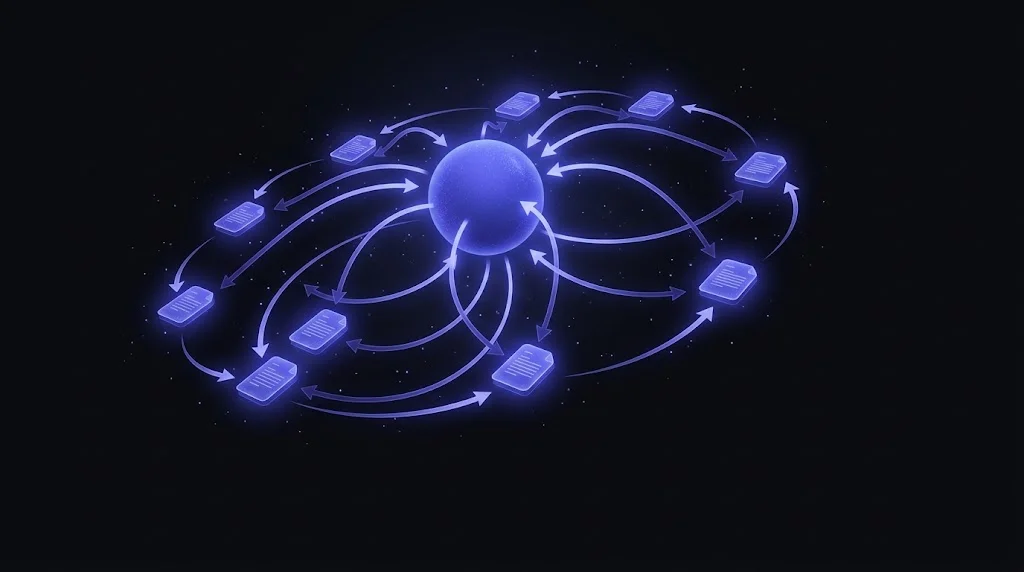
Agentic RAG puts an LLM agent in charge of retrieval. Instead of running one fixed search and hoping the chunks are right, the agent decides whether to retrieve at all, what to search for, which source to hit, how many times to loop, and whether the retrieved context is actually good enough before it answers. That single shift - from a static pipeline to a runtime decision loop - is what makes retrieval “agentic,” and it is the biggest reason RAG stopped hallucinating its way through hard questions in 2026.
What is agentic RAG (vs naive RAG)?
Naive RAG is a single fixed pass. You embed the user’s query, retrieve the top-k chunks from a vector store once, stuff them into the prompt, and generate an answer. It is simple and fast, and for straightforward lookups it works fine. The catch: if that first retrieval is bad, the answer is bad. There is no second chance, no check on whether the chunks even answered the question.
Agentic RAG puts an LLM agent in charge of the retrieval control flow at runtime. The agent treats retrieval as a set of decisions rather than a fixed step:
- Whether to retrieve at all, or answer directly.
- What to search for, and how many times to search.
- Which source to hit - a vector index, a SQL database, a specific collection, or the web.
- Whether the result is good enough, or whether it should loop back and try again.
A widely cited survey, “Agentic RAG: A Survey,” frames the field around query planning, retrieval orchestration, multi-hop reasoning, and self-reflection. In practice that means the system can reformulate a vague question, chain several retrievals together, grade what it found, and self-correct before committing to an answer. When retrieval fails, it does something about it instead of confidently answering from bad context.
How is it different from agent memory?
People conflate these constantly, so it is worth being precise. RAG retrieves from an external corpus - your documents, filings, tickets, code. It is read-only knowledge the agent pulls in to ground its answer. Agent memory is what the agent writes and updates about the user or the task over time - preferences, prior decisions, running context.
RAG answers “what does the knowledge base say?” Memory answers “what do I already know about this user and this conversation?” A serious agent uses both, and they are architecturally different. We go deeper on the distinction in AI Agent Memory vs RAG: What’s the Difference?, and rank the memory tooling in AI Agent Memory in 2026: Frameworks Ranked.
What techniques make RAG “agentic”?
There is no single “agentic RAG algorithm.” It is a toolbox of techniques, and most production systems combine several. Each one fixes a specific failure mode of single-shot retrieval.
| Technique | What it does | When to use |
|---|---|---|
| Query rewriting / decomposition | Rewrites a vague query into a clean search query, or splits a complex question into sub-questions retrieved separately then recombined | The user’s phrasing is messy, or one question secretly contains several |
| Iterative / multi-hop retrieval | Retrieves, reads, then retrieves again using what it just learned; backtracks when a step fails | Chained facts, e.g. “who is the CFO of the company that acquired X?” |
| Routing across sources | The agent picks the right index or tool per query - vector store vs SQL vs web vs a specific collection | Your knowledge lives in more than one place |
| Re-ranking | Retrieves wide and cheap, then re-scores candidates with a model that reads query and document together (a cross-encoder) to fix ordering | Nearly always - one of the highest-leverage RAG upgrades |
| Corrective RAG (CRAG) | Adds an evaluation step that grades retrieved docs before generation; re-searches, reformulates, or falls back to web search if quality is poor | You need a safety net against bad retrievals |
| Self-RAG | The model emits reflection tokens, grading documents for relevance and its own output for hallucination; loops back to transform the query if unsupported | High-stakes answers where hallucination is expensive |
| GraphRAG | Builds a knowledge graph from the corpus and retrieves over graph neighborhoods and communities instead of isolated chunks | Global “connect-the-dots” questions across many documents |
| Hybrid search | Runs dense (vector) and sparse lexical (BM25/keyword) retrieval in parallel and fuses results, commonly with Reciprocal Rank Fusion | You have exact terms, IDs, or error codes that pure vectors miss |
Two of these deserve extra attention. Re-ranking is the cheapest big win: retrieve a wide net with fast vector search, then have a cross-encoder re-score the top candidates by reading the query and each document together. It fixes ordering problems that embeddings alone get wrong, and it is worth adding even to an otherwise naive pipeline.
Hybrid search is the other quiet workhorse. Vector search is great at meaning but bad at exact strings - part numbers, error codes, function names, invoice IDs. Running BM25 keyword search alongside dense retrieval and fusing the results catches both, so a query for ERR_CONN_4032 actually surfaces the doc that contains that exact code.
Which tools implement it?
The 2026 stack has settled into a few clear layers.
Orchestration and retrieval frameworks:
- LlamaIndex - retrieval and indexing plus query engines and agents. The default choice when retrieval is the center of gravity.
- LangGraph with LangChain - graph and state-machine orchestration for retrieve then grade then decide then retry loops. This is the common choice for building CRAG and Self-RAG control flow, because those patterns are literally state machines with conditional edges.
- Haystack - typed component pipelines when you want strong contracts between stages.
Vector databases: Pinecone (managed, low-ops), Weaviate (native hybrid search), Qdrant (strong self-hosted option).
Rerankers: Cohere Rerank (managed) or open cross-encoders like BGE and Jina if you want to self-host.
A common 2026 production stack is LlamaIndex for retrieval, LangGraph for orchestration, and Ragas or LangSmith for evaluation. If you are already on Cloudflare, Vectorize plus AI Search are a managed option that keeps retrieval close to your Workers - we cover that path in the Cloudflare AI capabilities guide.
When does agentic RAG beat plain RAG (and what does it cost)?
Agentic RAG wins when a single retrieval is not enough. Specifically:
- Multi-hop or ambiguous questions that need to chain facts or clarify intent first.
- Corpora spanning multiple sources that need routing to the right index or tool.
- Cases where single-shot retrieval demonstrably misses and you can measure it.
- When abstaining beats guessing - the agent can self-correct or decline instead of confidently answering from bad context.
But it is not free. The costs are real and worth stating plainly:
| Dimension | Naive RAG | Agentic RAG |
|---|---|---|
| LLM calls | One | Several - planning, grading, reflection, retries |
| Latency | Low | Higher, hops run sequentially |
| Token spend | Low | Higher across the loop |
| Debuggability | Simple | More moving parts to trace |
| Best for | Simple lookup Q&A | Multi-hop, multi-source, high-stakes answers |
The honest guidance: do not reach for agentic RAG when naive RAG already works. For a support bot answering “what are your office hours?” from a single FAQ, the extra planning and grading calls are pure overhead. Add the machinery when the questions genuinely need it.
How do you evaluate it?
Because agentic RAG has multiple steps, you have to evaluate the retrieval quality and the trajectory, not just the final answer. A system can produce a right answer through a lucky path, or a wrong answer despite good retrieval - measuring only the last token hides both.
Use standard RAG metrics - faithfulness, answer relevancy, context precision, and context recall - to judge whether the retrieved context supported the answer. Then add trajectory checks: did the agent route to the right source, did it stop looping when it should have, did it retry after a bad grade? Tools like Ragas and LangSmith cover both layers. We walk through the full evaluation approach in How to Evaluate AI Agents in 2026.
What can you build with it?
The patterns show up cleanly across real use cases:
- Enterprise knowledge assistant - answers that span many documents need multi-hop retrieval plus routing across wikis, PDFs, and databases.
- Financial or legal research agent - decompose the question, pull from filings, contracts, and an entity graph, and verify before answering. This is where CRAG and Self-RAG earn their keep.
- Technical support copilot - hybrid search over docs, code, and tickets so exact error codes and function names surface alongside conceptual matches.
- Deep-research or competitive-analysis agent - iterative web plus internal retrieval with backtracking when a lead goes nowhere.
Each of these breaks a naive pipeline in a different way, and each maps to a technique from the table above.
Where to start
If you already have a naive RAG system, the highest-leverage first moves are adding a reranker and switching to hybrid search - both are cheap and both lift quality immediately. From there, add a grading step (CRAG) and routing only where your traffic proves you need them.
If you want a retrieval system that plans, routes, and self-corrects in production rather than a demo that falls over on the second hard question, our AI Agent Development team builds exactly this. And when the corpus is your internal filings, tickets, and databases, Enterprise AI Integration wires agentic retrieval into the systems your answers actually depend on.
Frequently Asked Questions
What is agentic RAG in simple terms?
Agentic RAG is retrieval-augmented generation where an LLM agent controls the retrieval process at runtime instead of running one fixed search. The agent decides whether to retrieve at all, what to search for, which source to query, how many times to loop, and whether the retrieved context is good enough before it commits to an answer.
How is agentic RAG different from naive RAG?
Naive RAG is a single fixed pass: embed the query, retrieve top-k chunks once, stuff them in the prompt, and generate. Agentic RAG adds planning, grading, and looping so a bad first retrieval does not become a bad answer. The agent can reformulate the query, retrieve again, switch sources, or abstain.
What is the difference between corrective RAG and self-RAG?
Corrective RAG (CRAG) grades the retrieved documents before generation and re-searches, reformulates, or falls back to web search if quality looks poor. Self-RAG has the model emit reflection tokens that grade both document relevance and its own output for hallucination, looping back to transform the query if the answer is unsupported.
When should I use GraphRAG instead of vector search?
Use GraphRAG when questions require connecting the dots across many documents - global, entity-heavy, or relationship questions like 'how are these three suppliers linked?'. It builds a knowledge graph and retrieves over graph neighborhoods and communities instead of isolated chunks, which plain vector search handles poorly.
Is agentic RAG worth the extra cost?
It depends on the questions. Agentic RAG is worth it for multi-hop, ambiguous, or multi-source queries where single-shot retrieval demonstrably misses. It costs more LLM calls, higher latency, and more debugging. For simple lookup Q&A where naive RAG already returns the right chunk, the extra machinery is not worth it.
Complementary NomadX Services
Related Articles
Get Started for Free
Schedule a free consultation with our AI agents team. 30-minute call, actionable results in days.
Every engagement is scoped by our principal architect, Adrian Vale: 20+ years in production engineering, 40+ professional certifications. Meet Adrian
Talk to an Expert